Restart Your Brain: ADHD-Friendly Tools for Handling Emotional Stress

EMOTIONS & SHAME

Restart Your Brain: ADHD-Friendly Tools for Handling Emotional Stress

Four faces experiencing emotional stress and one happy face

1. The Tool of Acceptance

2. The Tool of Mindfulness

3. The Tool of Humor

4. The Tool of Intuition

5. The Tool of Imagination

6. The Tool of Strategic, Therapeutic Daydreaming


ESP: Daydreaming on Steroids

  1. Find a little spare time — 10 to 20 minutes.
  2. Stop what you’re doing. Begin to slow your thoughts.
  3. Get into a comfortable position, sitting or lying down. Close your eyes and focus on your breathing. Imagine experiencing a sense of peace.
  4. Now begin to see an island or any other geographic feature, created by you, for you. It doesn’t have to be an island. It can be a galaxy far, far away or a tiny, magical closet, or a fairy garden. Think about positive experiences you’ve had, in places where you felt peaceful or serene. Remember times when all of your cares slipped away.
  5. Use the senses that most appeal to you — your sense of smell, sight, hearing, touch, taste. Tap into your senses to find what you need to nurture your soul. The more you use your senses, the stronger the neural net becomes.
  6. There are no limitations in your ESP — everything is possible, and if something doesn’t feel right, it disappears. This is not a place for judgment, criticism, or harm. These concepts do not exist in your Emotional Safe Place.
  7. Feel your connection to this place. Walk down any path that appeals to you. How do these surroundings make you feel? Relaxed? Happy? Nurtured? Adventurous? This is your place. Visit whenever you want.

33 Ways to Get Organized with Adult ADHD

http://www.additudemag.com/adhd/article/729.html?utm_source=eletter&utm_medium=email&utm_campaign=February


33 Ways to Get Organized with Adult ADHD

Want a clean home? An efficient office? Get organized with adult ADHD thanks to organizing guru Judith Kolberg and her 33 top strategies for work and home.

 12.9K  1893  4230  2850 + More PrintPrint
Get control of your life.ADDitude Magazine
There is no such thing as perfect organization.
Getting your life in order is a key step toward reaching your goals. No secret there. So why do we put up with chronic disorder at home, at work, and in our personal lives?
Judith Kolberg suggests it's a matter of perfectionism: We're unable to do what it takes to get even a bit more organized because we worry that we won't become perfectly organized. And as Kolberg, author of Conquering Chronic Disorganization, points out, there is no such thing as perfect organization. Life is capricious, and get-it-done strategies that work well today may prove useless tomorrow.
The good news, says Kolberg, who's now president of FileHeads Professional Organizers (www.fileheads.net), is that seemingly small changes can bring big improvements in your life--less clutter, fewer hassles, and greater tranquility.

The Big Picture

1. Set time limits for decision-making.
ADDers can spend days agonizing over decisions that others make in minutes. Speed the process by setting a time frame or a budget cap. If you're choosing a summer camp for your child, for example, set a deadline, and make the best choice you can by that date. If you're deciding which new cell phone to buy, pick a price cap and ignore more costly phones.
Always identify the most important factor to consider in making any decision, whether it's price, convenience, aesthetics, practicality, or something else. Focus solely on that factor when considering your decision.
2. Fight the tendency to over-commit.
For each new commitment you make, give up an old one. If you agree to join the school fund-raising committee, for instance, give up the neighborhood watch committee. ADDers tend to spread themselves too thin.
3. Keep your to-do lists brief.
Using big, bold letters, make a list of no more than five tasks on an index card. (List any additional items on the back of the card.) Once you have done those five things, refer to the back of the card to create a new to-do list--and discard the old one. You'll accomplish more, feel less frustrated, and manage your time better.


4. Fight hyperfocus.
Set an alarm clock, kitchen timer, or computer alert--or arrange for someone reliable to call you at a specified time or times. If you tend to lose yourself on eBay for hours at a time, you need this kind of help.
5. Use a "body double."
This is a friend or family member who sits with you as you tackle mundane chores, like balancing a checkbook, filling out a job application, or reviewing financial statements. Your body double will create a productive atmosphere by sitting quietly and doing an unobtrusive task, like affixing stamps to envelopes or clipping recipes from a magazine.

PERSONAL CARE

6. Keep extra medication on hand.
Each time you fill a prescription, write in your planner the date on which you'll need to renew it (or set your computer to issue an alert or generate an e-mail reminder on that date). Ask your pharmacist if he can call to remind you when it's time to refill. Your "renew date" should be at least one week before the date on which you'll run out of medication.
7. Build socializing into your schedule.
That way, your desires to meet new people, have interesting conversations, and keep up with friends are taken care of automatically. Take a class, join a book club or a lecture series, or start a dinner club.
8. Join an ADD support group.
Support groups provide more than emotional support. For example, the members can get together online when it's time to tackle boring tasks, like filling out tax returns or filing: One at a time, each person leaves the computer, dedicates 15 minutes to the task at hand, then returns to instant messaging--to joke, commiserate, and congratulate one another.
Find out more about online and in-person support groups at (addconnect.com).
9. Carry a colorful wallet.
It's harder to misplace a red wallet than an ordinary black or brown one. The same goes for your checkbook.
10. Buy experiences, not objects.
There's nothing wrong with a little "retail therapy" to reward yourself for your accomplishments. But think twice before buying some new object (which may become just another bit of clutter in your home). Instead, use your money to buy a pleasant experience, such as a massage or a night out with friends.

CLUTTER CONTROL

11. Stop agonizing over insignificant items.
What to do with greeting cards you've received, batteries of dubious power, unidentified CDs and cassette tapes, orphaned screws, and so on? Toss them into a "ripening drawer." Once the drawer is full, quickly sort through it. Use what you can, and discard the rest. Then start the process anew.
12. Get a "clutter companion."
This is a (nonjudgmental) friend or family member who will help you get rid of all the stuff that's cluttering up your house. A few times a year, you and your companion should sort your clutter into four piles: "keep," "toss," "donate," and "age." Discard the "toss" items at once--before you have a chance to change your mind. Place "donate" items in heavy-duty garbage bags, and drive them to the nearest donation bin. Place "age" items in a cardboard box marked with a date three months hence. In your calendar, mark the same date as the time to "review age items." When that date rolls around, give those items another look. If you feel comfortable discarding them, do so. If not, renew the date for another three months.
13. Fight financial-statement overload.
Do you really need to keep monthly account statements? Ask your accountant if you can get by with keeping only quarterly or annual statements--and toss the rest.


14. Don't let unread magazines pile up.
If the next issue arrives before you've read the last one, place the last one in a small basket (measuring no more than six inches high and two magazine-widths across). Once the basket fills up, sift through the magazines. Read what you can, and discard or recycle the rest. (You might drop off the best magazines at a hospital or women's shelter.)
If you are habitually unable to keep up with the issues of a particular magazine, cancel the subscription.

YOUR DAILY ROUTINE

15. Make use of "wasted" minutes.
Don't wait to find long blocks of uninterrupted time to tackle organizational chores. In one minute, you can sort mail, remove lint from the dryer, or water the plants. In five minutes, you can empty the dishwasher or write an e-mail. While you wait for your laundry to dry, you can mate socks and gather clothes for dry cleaning.
16. Create a "launch pad" near the front door.
This is the place to stash things that family members need each time they leave the house--umbrellas, school backpacks, briefcases, pocketbooks, keys, scarves, and so on. The launch pad might have cubbies, pegs, hooks, containers--anything that makes it easy to find and grab things as you head out the door.
17. Ditch those receipts.
Each evening, empty your pockets, wallet, purse, and briefcase of all ATM slips and receipts. Put them in with your stack of bills to be paid and financial statements to review.
Too much loose change? If coins pile up on your dresser, get a jar to put them in. At the end of the month, you'll have an extra $15 or so to spend--a reward for keeping your pockets free of clutter.
18. Simplify your wardrobe.
The more clothes you have, the harder it is to decide what to wear each morning. So continually winnow out extra clothing. If you get a new shirt, for instance, consider getting rid of an old one. In spring and summer, coordinate all your clothing around only two colors, plus white. In fall and winter, coordinate all your clothing around two other colors, plus black. You'll feel liberated by having fewer outfits to choose from--and you'll save money on clothes.
19. Pre-assemble your clothes into complete outfits.
Hang them on sturdy hangers in your closet. You'll get dressed faster each morning, with less confusion and second-guessing. This strategy works for men and women alike, and is especially helpful for organizing business attire. Women can slip a baggie with matching jewelry onto the hanger. For items to help organize children's clothes and toys, take a look atDays of the Week Closet Organizer on Amazon.com.

Organize Your Life, Part 2

AROUND THE HOUSE

20. Take it one project at a time.
Having to tackle several big projects at once is stressful for people with ADD. Set one priority, and get it done, tying up all loose ends before moving on to a new project. For instance, get new eyeglasses before cleaning your gutters. Or take your car in for maintenance before revising your résumé.
21. Use sticky notes to stay on track.
If you're often sidetracked by interruptions, make it easy to return to the task at hand once the interruption is over. How? Keep a supply of sticky notes with you, and jot down where to pick up again. For instance, if you must take a phone call while reading, post a note on the text that says, "resume reading here." When the call is over, you'll know exactly what to do.
22. Double up on tasks.
If you can make it a habit to do two small things in concert, you’ll get more done. For example, you might reset your clocks and change the batteries in your smoke detectors upon the end of Daylight Saving Time each autumn. You could change your oil and balance your investments on the same day. Or reorganize your pocketbook each time you water the plants.
23. Organize your garage like a professional.
That means separating your stuff into "zones" of the sort you see at home-improvement stores: "tools," "painting supplies," "gardening supplies," "sports equipment," "automotive," and so on. If this job is too big to tackle on your own, don't be reluctant to ask for help.

THE PAPER TRAIL

24. Rethink your filing system.
ADDers often have trouble with filing because they create too many categories. Better to keep your categories broad, and use subfolders where necessary. For instance, you might label one folder "insurance," and fill it with subcategory folders for life insurance, car insurance, and health insurance.
Online retailer www.addconsults.com offers a variety of terrific organizing products, including one designed specifically for keeping track of owner's manuals, product warranties, insurance policies, and the like.
25. Create a document "hot spot."
This is a red, see-through folder for important, time-sensitive documents. In this folder, which should be kept on your desk, you should place papers representing up to five different tasks that must be attended to within the next 24 hours--an overdue bill, a client file, a phone message to return, and so on.
Clear out your hot spot daily. Active papers that aren't yet urgent should be kept in transparent file folders arranged vertically in a file holder.
A hot spot is a great tool for dealing with the "out of sight is out of mind" problem.
26. Stanch the flow of junk mail.
Add your name to the "do not send" list maintained by the Direct Mail Association. Go towww.the-dma.org for more information.
27. Process the mail every day.
That will keep you from feeling overwhelmed. Throw out junk mail immediately. The rest of the mail should be kept in one place, with a wastebasket nearby. Bills to be paid should be placed inside your checkbook or--if you use online banking--on the desktop beside the computer. Stick everyone else's mail into nearby cubbyholes, slots, or shelves with their names on them.

MONEY MATTERS

28. Schedule a quarterly review of investments--with yourself.
Write the date and time to review these on your calendar or in your planner, and go over your bank accounts, investment accounts, and retirement plans.
29. Switch to online banking.
How much time do you spend each month writing checks, addressing envelopes, and affixing postage (not to mention mailing the checks)? It's faster to do your banking online--especially since you can set up recurring bills to be paid automatically--and you won’t have to pay for postage.
If you're intimidated by the sometimes-complicated computer work required to open an online account, ask a computer-savvy friend or family member to help.
30. Use a single checking account.
Keep your checkbook in your purse or briefcase and return it there immediately after using it. Keep your check register and a few emergency checks (but not another checkbook!) in another location, in case you lose your checkbook.
31. Keep plastic to a minimum.
The more credit cards you have, the more statements and receipts you'll have to contend with. Better to stick with one or two major cards and avoid the high-interest store and gas cards. Consider new card offers only if the terms of the card are clearly superior to the terms of your current cards.
32. Get a debit card.
Keep it in your wallet, and use it instead of a personal check whenever possible. Each time you use the card, make an entry in your check register as if you had written a check. That way, your checking account stays balanced.
33. Keep some extra cash on hand.
Put several hundred dollars in a waterproof plastic bag and place it someplace safe but easy to locate (maybe your freezer). That way, you won't be caught empty-handed if a storm, power outage, or some other natural or man-made disaster makes it impossible to use ATMs.

15 Genius Tips for Living in Small Spaces

From: http://joannagoddard.blogspot.com/2014/01/15-genius-tips-for-living-in-small-space.html


Erin Boyle of Reading My Tea Leaves and Gardenista and her husband live together in seriously small quarters—a 240-square-foot studio, to be exact. She agreed to share her surprising tips about how to make it work (and not drive each other crazy)...
Erin's story: When my husband James and I moved into a 240-square-foot apartment in Brooklyn Heights, we negotiated a six-month lease because we weren’t sure we’d be able to make it in such cramped quarters. (Our apartment is a studio with a ship’s ladder to a sleeping loft, plus one tiny bathroom.) Two and a half years later, we’re still in our very humble abode, and gearing up for a whole new adventure coming in 2014: a very tiny addition to the family headed our way this June.
1. Maximize your windows. Drape your windows in a way that allows for maximum light—I’d go for the bright white curtains—and try hanging a mirror nearby to reflect light into the room. Remembering to clean the windows helps, too!
2. Choose simple furniture. We’ve found that furniture with simple and spare lines makes a tiny apartment feel roomier. (Our couch is the tiny Elton Settee and it fits perfectly in our “living room.”)
3. Remove closet doors. Closet doors that swing into a room take up considerable floor space. Take the doors off and ask your landlord to store them. Then hang a simple curtain from a suspension rod to hide the inside of your closet instead.
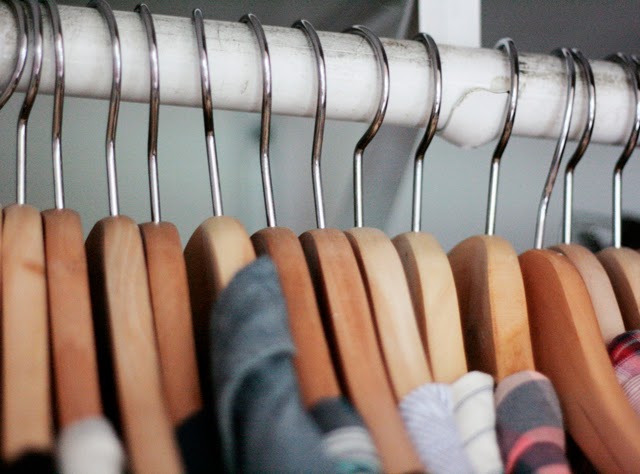
4. Keep closets organized. Our old wooden hangers are, admittedly, wide and bulky; these huggable hangers would probably do the trick much better.
5. Play a romantic song. In the heat of an argument, you and your partner may both crave space—but in a small apartment, there’s nowhere to go. Here’s a trick: Play a love song. Emotional distance from the fight is more important than physical distance. It's really hard to keep your blood boiling when you’re listening to a song you love, with the person you love, about love. It's like putting on a lullaby to soothe a crying baby.
6. Give yourself permission to say no to overnight guests. Our apartment has just enough space for one guest to sleep on the floor, head wedged between the ladder to the loft where we sleep and our loveseat, feet reaching nearly into the bathroom. It's okay to explain that you don't have the space to accommodate overnight guests.
7. Streamline your music collection. Tragic though it might be, tiny apartments likely don’t have space for the entire vinyl discography of The Beatles. Swallow your pride and go digital. We’re total radio junkies so we have a Tivoli radio, which also plays the music from our iPhones.
8. Invest in beautiful cleaning supplies. No broom closet to be seen? Swap the plastic broom and dustpan for something pretty and you won’t mind looking at them hanging from a hook or propped in the corner. (Brook Farm General Store is my go-to stop for fancy brushes and dust pan, and we buy Common Good dishwashing liquid and cleaning spray in bulk.)

9. Tiny things matter, too. Move into a tiny apartment and expect an onslaught of tiny gifts. (Look! A mini muffin pan! Tiny spoons!) Try to spread the message to well-meaning friends that tiny things can be as difficult to store as large things. Ask for comestibles instead!
10. Use quick-drying towels. We're linen towel converts. Our tiny bathroom doesn’t get much ventilation, but linen towels dry so quickly that there's no musty smell to contend with. (We recently upgraded to these pretty linen chambray towels from Fog Linen.)

11. Use an absorbent hand towel as a bath mat. There are very few bathmats on the market that fit in a truly tiny bathroom. We use a quick-drying hand towel instead. (These white Hammam Hand Towels are absorbent enough to keep the floor from getting soaked and just the right size for the tiny bit of floor space we have. Bonus: they’re easier to drag to the laundromat!)
12. Keep bedding simple. We used to have a bright floral quilt, but it made our tiny loft feel tinier. We also experimented with darker sheets but returned to crisp whites. Simple bedding is easier on the eye and makes the apartment look bigger. (We love our Brahms Mount Ticking Stripe Blanket.)

13. Unpack suitcases right away. In our tiny apartment, an unpacked bag causes stubbed toes and violent bouts of cursing. Even if we return home from vacation in the wee hours of the morning, the first thing I do is to unpack my bag. There’s nothing more delicious than waking up in my own trusty bed knowing that everything's just where it should be.
14. Embrace under-the-bed storage. My sister manages to live in a 390-square-foot apartment with a baby and a husband and keep nothing under the bed. In case you’re not blessed with similar minimalist super powers, use the space under your bed to keep winter clothes, extra blankets, and that guitar you haul out three times a year. (Muji’s soft storage boxes have been a godsend for us.)

15. Treat the whole dang city like it's your living room. We sit on the church steps across the street for weekend lunches and after-dinner treats. And if there's a public park in this city, chances are that we've picnicked in it or strolled through it. A few numbers to help you understand why: Central Park: 843 acres; Prospect Park: 585 acres; Brooklyn Bridge Park: 85 acres; The High Line: 6.73 acres; Our apartment: 0.005509 acres.
Overall advice: Approach your tiny apartment joyfully. I get more notes than I could ever answer from people who are nervous about an upcoming move to a tinier place. Here's the one bit of advice I can offer universally: See it as an exciting challenge and not as an impending nightmare. It is what it is!

Thank you so much, Erin! (I especially liked the tip about playing a romantic song after an argument.) Any advice you would add? Read more of Erin's many tips on Reading My Tea Leaves. xoxo

P.S. A 500-square-foot apartment in San Francisco, and a great book about small spaces.

(Photos by Erin Boyle; the bedroom plant photo originally appeared on Gardenista)

8 Sneaky Ways to Create the Illusion of More Space

From: http://www.apartmenttherapy.com/8-sneaky-ways-to-create-the-illusion-of-more-space-206228

Pin it button big

There are plenty of ways to "open up" your living spaces by fooling the eye to make others (and yourself!) think that your home is much, much larger than it actually is. It doesn't always require tearing down walls or major renovations (although sometimes those help too)! Check out this bag of tricks at your disposal, and see if any work for you.

Pin it button big
Choose Monochromatic Colors

Monochromatic schemes are more peaceful as a rule, as the eye can move easily around the room without abrupt interruption by other colors. Use different color values add depth and interest to the space.

Pin it button big
Go With Glass

If you are doing a bathroom renovation, choose glass shower doors over a shower curtain, which becomes a visual barrier instead of letting your eyes take in every inch of space that exists. Similarly, you can replace wooden doors for french doors, or any doors with interior glass panels.

Pin it button big
Hang Mirrors

You can choose either individual mirrors, or mirrors that go from floor to ceiling, to reflect light and make a small room feel more open. Think about what parts of the room you wish to have reflected before hanging anything.

Pin it button big
Choose the Right Furniture

Avoid heavy, solid furniture or skirted sofas. Instead choose pieces on raised legs, or made of clear materials, that have less visual weight.

Pin it button big
Unify Your Flooring

Solid continuous flooring makes rooms look far more spacious. Don't break up your room by installing linoleum in the kitchen space, and hardwood in the living room. Also, avoid most patterned carpets and rugs (although stripes that run vertically through the room can make the room feel longer).

Pin it button big
Lower Your Lighting

Ensure that you have lighting at floor, table and eye level to help limit shadows versus ceiling lights. That means hanging any pendant lamps as low as possible.

Pin it button big
Raise & Widen Your Curtains

Extending the curtain rod beyond the actual window- both in terms of height and width, makes you think the window is larger, and the ceilings taller, than they actually are. If there are two or more windows side by side, try one curtain on the entire wall – hanging separate pairs unnecessarily chops up the space.

Pin it button big
Use Paint Strategically

Choose a wall color that's the same as your flooring so that the edge where they meet is less noticeable. Paint the walls and trim in similar shades of one color. Lastly, create the illusion of high ceilings by continuing the wall color onto the ceiling, making wall appear taller in the process.

What other tricks have you learned over the years?

(Image credits: Adrienne Breaux; Andrea Sparacio; Lindsey Kay Averill; Nicole Crowder; Jenny J. Norris; Alexis Buryk; Submitted by John; Carolyn Purnell; Michael Alan Hoy)

11 Top Tips For Keeping Your Home Clutter Free

Cluttered Garage

(LS) — George Carlin once wisely observed that a home is just a place for your stuff. The problem is that many people keep on accumulating stuff, but they can’t bring themselves to part with any of it. Stuff just keeps piling up and piling up, and spilling over into garages and attics and storage spaces until something simply must be done about it. The following is list of helpful ways to cut down on the clutter in your home before you end up embarrassing yourself on Hoarders:

  • Dispose of old clothes. I know that you could always lose weight, but the chances of getting back into those size 32 jeans from high school when you’re wearing 44s is pretty slim… if you’ll excuse the pun. In reality, if you haven’t worn something in a year, then it’s time to get rid of it. Furthermore, you can always donate the clothes to the unfortunate and turn de-cluttering into an act of kindness.
  • When something breaks, get rid of it. For three years, I had a broken lawn mower sitting in my garage. I don’t know how to fix a lawnmower, and I own a better mower. Eventually, I put it up on craigslist, and ended up with enough money for a decent pizza. And, now there’s enough room in the garage for the kid’s bike.
  • Hang bikes on hooks and tools on nails in the garage. It’s amazing how much less clutter you’ll have in your garage when the bikes are stored up in the air on hooks, and the tools are neatly in their proper place on nails.
  • Recycle those old books. Both my fiancĂ©e and I were English majors in college, so our library multiplies faster than bunnies. The room is lined with bookshelves that are stuffed to the seams with books. Piles stack up at the feet of each one. Once a year, we cull the heard and take the rejects to Half-Priced Books for a little spending money.
  • Get some file cabinets. A sad byproduct of adult life is the stacks of paper that can quickly accumulate – bills, receipts, and records. The only way to responsibly keep track of all of that stuff is with a filing cabinet. And, when the records get too old, recycle that paper. I assure you that you won’t miss the cable bill from 1996. You have a dish now, anyway.
  • Outgrown toys must go. This is a tough one for many children. We know you loved Betsy Wetsy when you were little, Janey, but you’re 14 now. It’s time to give it up. Nobody is playing the PlayStation 1 anymore. When your children no longer use their toys, it’s time for a garage sale. If you can’t sell them, then put them by the curb. Somebody will come along and take them away.
  • Thin out the medicine cabinet. There’s very little reason you’re going to need the allergy eye drops that were prescribed in high school but just can’t bring yourself to part with. When it comes to medicine, you’re not just getting rid of clutter, but you could be saving your life.
  • Freezer burn isn’t your friend. Go to your freezer right now. Go. Stop reading this. Tell me you don’t find at least one frozen vegetable that’s been in there over a year and is so covered in ice you’d use it as a centerpiece for your table rather than a side dish for dinner. Throw it out.
  • Sort through the linens. Any towels with frays – gone. The fitted bed sheet you tore with your toenail last spring – gone. The old comforter Fido used in his dying days – gone.
  • Rent a storage space. You can’t just keep piling the stuff you don’t want in the house, in the garage, or up in the attic. The dry wall floors in most attics can’t handle the weight. And we know it’s hard for some people to part with the rotten old moose’s head you had on the wall in college. Rent a small storage space, and get it out of the house.
  • Find a place for everything and put it there. When things are put in their place, the house is simply less cluttered. Of course, there’s a limit to this. Move the bottle of ketchup two inches to the left in my uncle’s fridge, and he’ll go move it back. You can take de-cluttering too far.

De-cluttering isn’t just about making the house more presentable for visitors, but when your house is less cluttered, you can keep it cleaner, safer and healthier for your family. It’s ok to have a place for your stuff, just not so much stuff you can’t see the place.